
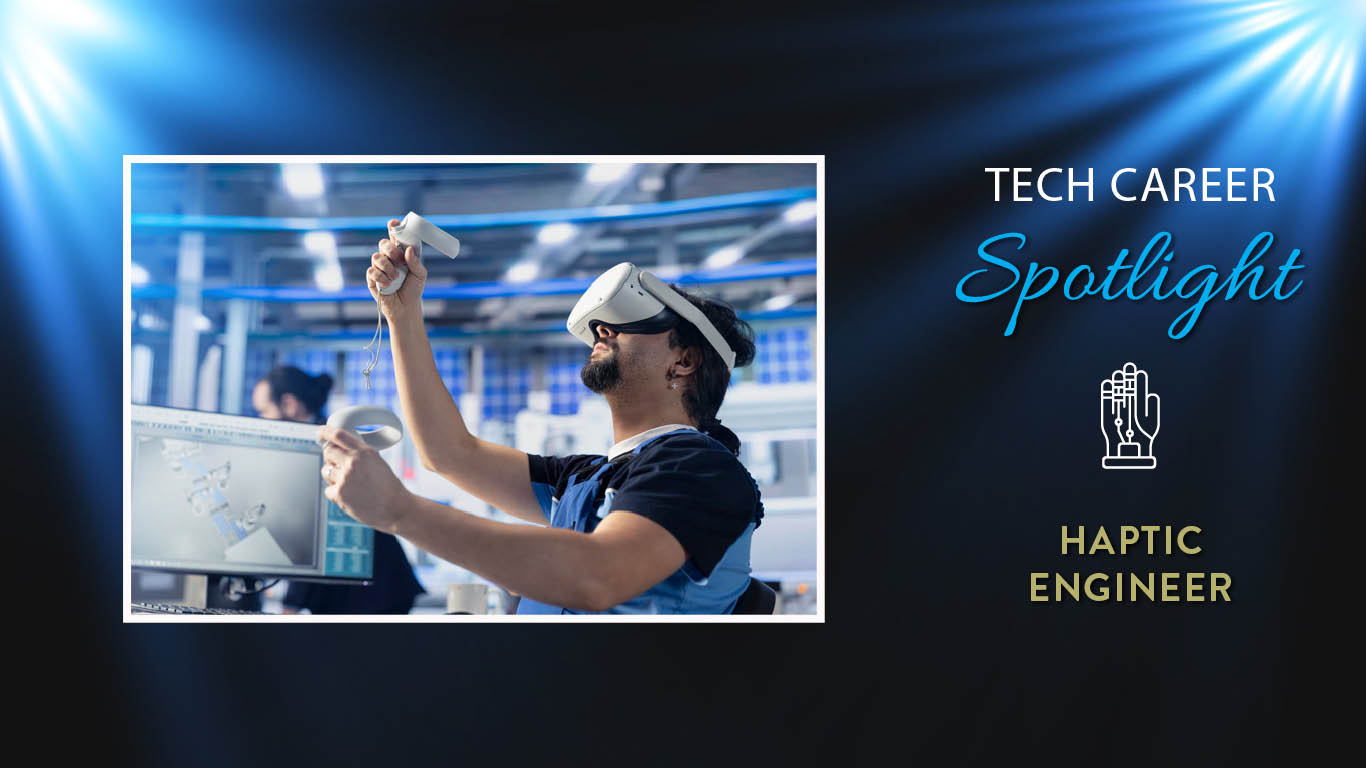
You know that gentle vibration in your pocket when you get a text? Or the not-so-gentle shake of your controller when your gaming hero crashes into something? That’s haptic technology. From the Greek word for “touch,” haptic engineering makes the tools and tech we use every day something we can feel, not just see or hear.
What they do
Haptic engineers design technology that recreates the sensation of touch using vibrations, pressure, and movement. They combine engineering, computer programming, and an understanding of how our bodies respond to physical sensations.
Their work can be as simple as creating the gentle tap you feel on your wrist when your smartwatch sends an alert or as complex as developing virtual reality (VR) equipment that makes us feel like we’re touching objects that aren’t really there.
How they can help
Haptic technology does more than make video games exciting. It can make technology safer, more accessible, and easier to use. For example, your car’s steering wheel might vibrate to warn you when you drift out of your lane or get too close to the car in front of you. Medical students can use haptic simulators to practice procedures and experience realistic resistance without working on actual patients. And people with visual or hearing impairments can receive important information through touch rather than sight or sound.
As technology advances, haptic engineers are also exploring ways to make remote activities feel more realistic, from operating machinery at a distance to practicing hands-on skills in virtual classrooms. The U.S. Navy, for example, has explored haptic technology that lets sailors practice tasks like turning valves and repairing equipment aboard virtual ships and submarines, without ever setting foot on the real vessel.
What tools they can use
Haptic engineers work with a combination of physical equipment and computer software. Such tools include:
- Sensors: Devices that detect touch, pressure, or movement.
- Actuators: Tiny motors or other components that create vibrations or physical sensations.
- Computer design software: Programs that help engineers design and test their inventions before building them.
- Programming languages: Tools such as Python and C++ that help engineers develop and program.
- Testing equipment: Instruments that measure vibrations, forces, and how accurately a device reproduces the intended sensation.
Where you can start
Most haptic engineers come from an electrical or mechanical engineering background but are also confident with computers (specifically how computers and humans can work in concert) and advanced programming languages and development tools like MATLAB or Unity. Younger students should consider a robotics club or a programming class as well as building a foundation on physics and math courses. As experience grows, prospective haptic engineers might consider a Python Bootcamp or a Unity Programmer Certification to bolster their resume.
If you’re a creative problem solver and a sound communicator who “speaks robot” and wants to make technology feel more human to humans, you may have just found the career for you!